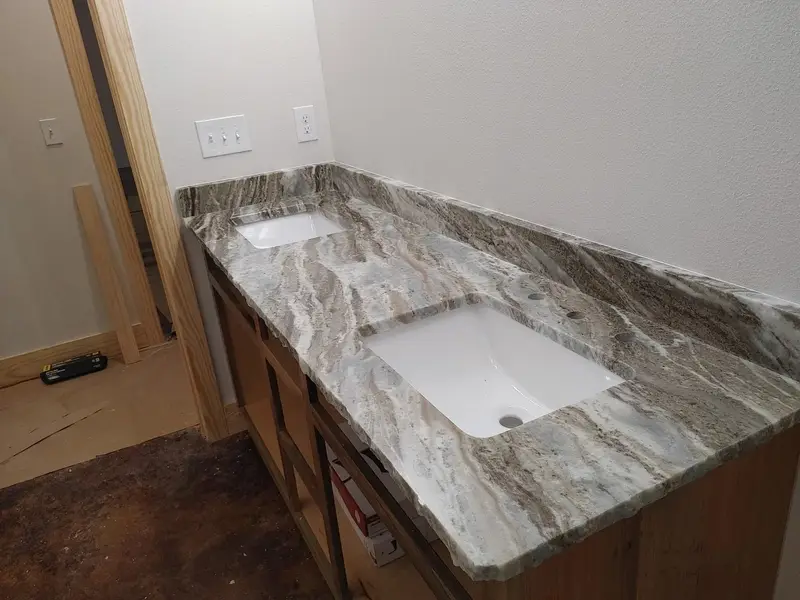
Stone GuidesSpills
Rust Stain on Granite: What Works and What to Avoid
Rust is the hardest stain to get out of granite, and the wrong rust remover can damage the stone. How to spot it, the poultice for it, and when to stop and call.
An orange or brown mark in the shape of a can, a pan or a pot stand is usually rust. It is the hardest stain to get out of granite, and the store shelf holds a product that can make things worse. So go slowly with this one.
Everything below comes from the Natural Stone Institute, the trade group for the natural stone industry.
How to Know It Is Rust
The Institute says “Iron or rust stains are orange to brown in color and follow the shape of the staining object such as nails, bolts, screws, cans, flower pots, metal furniture.”
In a kitchen that usually means a cast iron pan set down wet, a metal can left by the sink, or a pot stand with a worn finish. If the mark has the outline of something metal, treat it as rust.
The Warning to Read First
The obvious move is to grab a rust remover. Be careful. The Institute says “Many commercially available rust removers (laundry rust stain removers, toilet bowl cleaners) contain trace levels of hydrofluoric acid (HF).”
That acid is the problem. The Institute says “This acid attacks silicates in addition to other minerals. All stones, including granite and quartzite, will be attacked if exposed to HF.”
So do not scrub a rust remover onto granite. Read the label first, and if it lists hydrofluoric acid, keep it away from your stone.
The Institute’s Method: A Poultice
The Institute says “Metal stains must be removed with a poultice.” A poultice is a paste that pulls the stain out of the stone as it dries.
For iron and rust, it says to “Poultice with diatomaceous earth and a commercially available rust remover.” That is the same kind of product the warning above is about, so the label matters. If you cannot tell whether a product is safe for stone, stop and call us before you use it.
The Institute’s poultice steps, short version:
- Mix it “to a thick paste the consistency of peanut butter.”
- “Wet the stained area with distilled water.”
- Spread it 1/4 to 1/2 inch thick, and “extend the poultice beyond the stained area by about one inch.”
- “Cover the poultice with plastic and tape the edges to seal it.”
- “Allow the poultice to dry thoroughly, usually about 24 to 48 hours.”
- Remove it, then “Rinse with distilled water and buff dry with a soft cloth.”
Our oil stain guide walks through each step in more detail.
Be Ready for It to Take a While
The Institute is honest about rust. It says “Rust stains are particularly difficult to remove. You may need to call a professional.” It also says “Deep-seated, rusty stains are extremely difficult to remove and the stone may be permanently stained.”
The deeper it has soaked in, the harder it is to lift, so start soon.
Never Mix Products
If you try one product and then another, rinse well with plain water in between. The Institute warns: “DO NOT MIX BLEACH AND AMMONIA! THIS COMBINATION CREATES A TOXIC AND LETHAL GAS!”
How to Keep Rust Off Granite
- Dry cast iron pans before you set them on the counter.
- Keep metal cans, like shaving cream or cleaning sprays, off wet stone, especially by the sink.
- Use a plate or a tray under anything metal that stays on the counter.
Sources
Fernando's Recent Work
Every photo is a job Fernando templated and installed himself. See all our work