Stone GuidesSpills
How to Remove Stains From Marble Countertops
Dark spot, dull spot or a ring? On marble those are three different problems. How to tell them apart, and the fix for oil, food, ink and water rings.
Marble marks more easily than any other countertop stone, so it pays to know what you are looking at before you clean it. A dark spot, a dull spot and a white ring all look like “a stain,” but each one needs a different fix.
The steps below come from the Natural Stone Institute, the trade group for the natural stone industry, from the stone supplier MSI, and from Use Natural Stone, the Institute’s website for homeowners.
Start Here: Blot, Then Rinse
For any fresh spill, MSI says: “Never rub or wipe a spill; blot immediately and follow with a solution of pH neutral dish soap and warm water.” Dry it with a soft towel.
Wiping spreads the spill over more of the stone. Blotting keeps it small.
Dark, Dull or White: What Kind of Mark Is It?
A dark spot is usually a stain. Something soaked into the stone, like oil or coffee.
A dull spot is usually an etch. The Natural Stone Institute says “Etch marks are caused by acids left on the surface of the stone.” An etch is not something that soaked in, so stain removers do nothing for it. Our etching guide covers how it gets polished out.
A white ring or spot is often hard water. The Institute files water spots and rings under “surface accumulation of hard water.”
Sometimes it is two at once. The Institute says “Some materials will etch the finish but not leave a stain. Others will both etch and stain.” Red wine and tomato sauce can do both.
The Institute’s advice when you are not sure: “If you don’t know what caused the stain, play detective.” Think about where it is and what sits near it.
Oil on Marble
Use Natural Stone says “Marble can also become stained; two of the biggest culprits are red wine and oil.” An oil stain looks darker than the stone around it.
The Natural Stone Institute’s oil steps are the same for every natural stone. For a set stain, it says to “Clean gently with a soft, liquid cleanser with bleach OR household detergent OR ammonia OR mineral spirits OR acetone.” Pick one, never two.
For a stubborn oil stain, the Institute says to “Poultice with baking soda and water OR one of the powdered poultice materials and mineral spirits.” A poultice is a paste that pulls the stain out as it dries. Our oil stain guide walks through making one, step by step. The steps are the same on marble.
Food, Coffee and Tea
The Institute calls these organic stains and says they “May cause a pinkish-brown stain and may disappear after the source of the stain has been removed.”
For one that stays, it says to clean indoors with “12% hydrogen peroxide (hair bleaching strength) and a few drops of ammonia.” Wear gloves and open a window. Our red wine guide has the full steps for this kind of stain.
Water Rings and Spots
For water spots and rings, the Institute’s fix is short: “Buff with dry 0000 steel wool.” Use only that grade, 0000, which is the finest, and buff gently.
If the ring is dull instead of white, it is probably an etch from what was in the glass, not the water.
Ink and Marker
The Institute says “Clean with bleach or hydrogen peroxide (light colored stone only!) or lacquer thinner or acetone (dark stones only!)” On light marble, that means bleach or peroxide, not acetone.
What Never to Use on Marble
MSI is firm about this: “NEVER use vinegar, commercial cleaners, bleach, ammonia, or scrubbing pads as they can etch the surface of the marble.” Its everyday list of things to avoid includes “vinegar, lemon juice, or other cleaners containing acids or harsh chemicals.”
Here the sources disagree. The Institute’s stain steps list bleach or ammonia for some stains, and MSI says never to use them on marble. Because of that, call us before you put either one on marble. And never mix the two. MSI says to never “Mix bleach and ammonia; this combination creates a toxic and lethal gas.”
For everyday cleaning, MSI suggests “1 tablespoon of a gentle dish soap in a spray bottle,” filled with warm water.
How to Keep Marble From Staining
- Wipe spills right away, especially wine, oil, coffee and tomato.
- Use coasters, cutting boards and trivets.
- Keep the seal in good shape. We seal every natural stone slab before we install it. Use Natural Stone’s simple test: put a few drops of water on the stone, and “If it leaves a dark spot, it has soaked into the stone and needs to be sealed.”
Sealing slows stains down. It does not stop etching. As one stone restorer told Use Natural Stone, a sealer “does nothing to protect etching, no matter how much sealer you use.”
Sources
Fernando's Recent Work
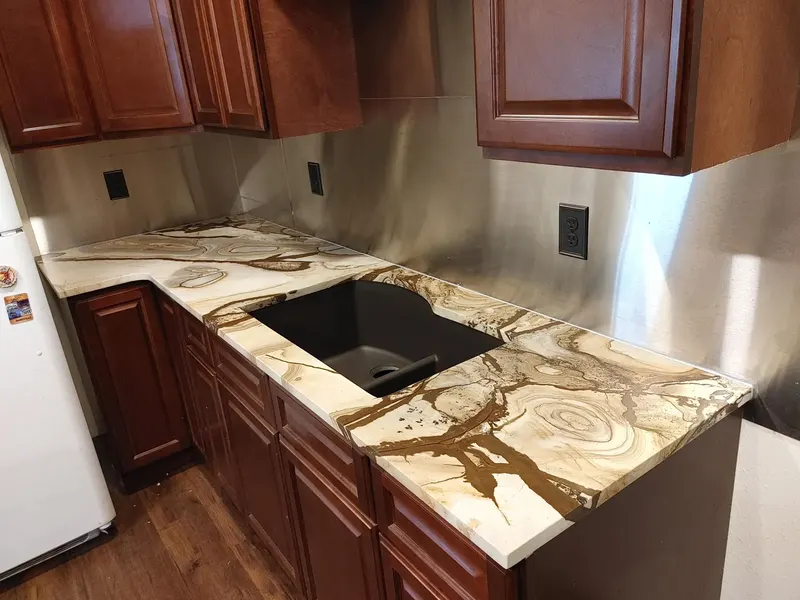
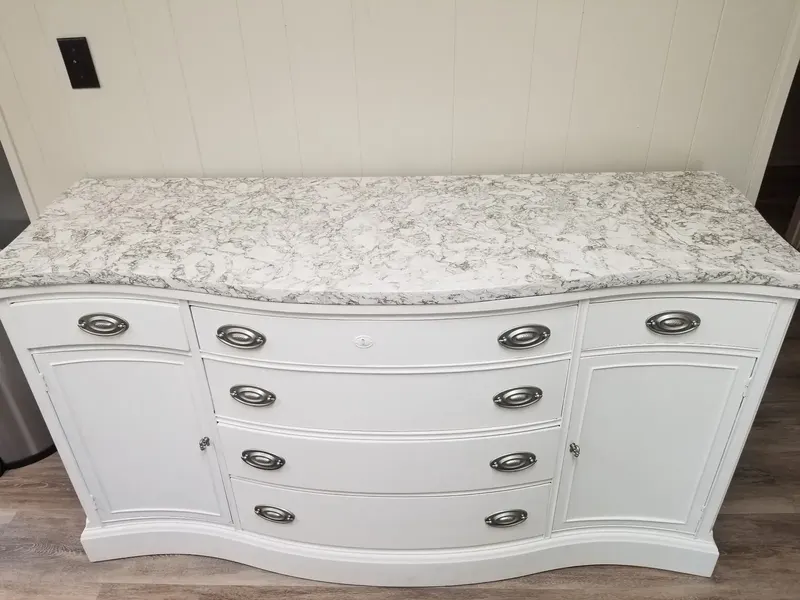
Every photo is a job Fernando templated and installed himself. See all our work