Stone GuidesIs This Normal?
Countertop Seams: Why They Happen and What Is Normal
Most kitchens need at least one seam, because slabs come in fixed sizes. What a good seam looks like, where it should go, and what to ask before anything is cut.
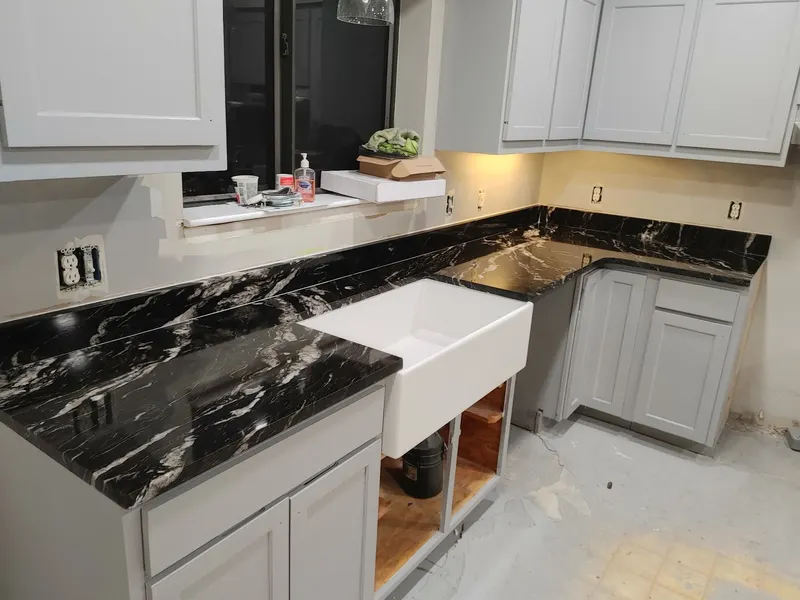
A seam is the line where two pieces of countertop meet. Most kitchens have at least one. That surprises people, so here is why, and what a good one looks like.
The facts below come from Cambria and MSI, two of the large quartz makers. Most of it applies to granite and other natural stone too.
Why Seams Happen
Stone comes in slabs of a fixed size. Cambria says “quartz slabs are typically available in standard, fixed dimensions,” and that this is true of “all other stone surfaces” too. Its standard slab “measures 122x55.5″ (47 square feet).”
A kitchen often needs more than that. Cambria says an average size kitchen has 50 to 100 square feet of countertop, so “you’ll likely need more than one slab to cover your countertops,” and “those slabs must be joined by a seam.”
Shape matters too. Cambria says L shapes, U shapes and complex turns “often make seams a structural necessity.”
Smaller pieces often have none. Cambria says “Smaller-scale quartz installations such as bathroom vanities and kitchen islands may be seamless.”
What a Good Seam Looks Like
You will see it. Cambria is plain about that in its own product terms: “Cambria Product is not a seamless product; seams are visible.” It adds that “while a fine line will exist at any seam with any stone, experienced installers use advanced techniques to make stone surface seams incredibly tight and inconspicuous.”
How tight? “Cambria’s guidelines state that finished quartz seams should not exceed 1/32 of an inch in width,” which it compares to “roughly the thickness of a single credit card.” That is Cambria’s rule for its own quartz, not a rule for every stone.
The seam is glued. Cambria says it “is permanently joined with a specialized adhesive,” and “Typically, installers match stone adhesives to the dominant background color of the slab.”
Expect the pattern to shift a little across it. Cambria says “Where there are seam changes in the product pattern and shade will be visible.” On natural stone, the veins do not always match perfectly either.
Where a Seam Should Go
Away from the sink, usually. Some people ask for seams at the front and back of the sink, because they are short there. Cambria says “many installers have moved away from this technique,” because “You probably stand at your sink more than any other place in your kitchen.” A seam there “could potentially make it more noticeable.”
Where the pattern can flow. With bold veins, the layout matters most. Cambria says what most people really do not want “are seams where the slab design isn’t well matched across the seam.” MSI says something similar: in large or complex kitchens, seams “are sometimes unavoidable,” and bold patterns may show them more.
Corners and natural breaks. Cambria suggests placing seams “more discreetly toward corners or natural breaks in the countertop layout.”
Waterfall Edges
A waterfall edge is where the countertop turns and runs down the side of an island to the floor. Cambria says that is “two pieces of quartz slab seamed together at the edge where the product goes over the side.” The vein pattern may shift at that corner if the side piece comes from a different slab.
What We Do
On every job, Fernando places seams where the slab sizes allow and works to line up the veins. Natural stone does not always match perfectly, so if you care where a seam goes, tell him early.
Is My Seam a Problem?
A thin line where two pieces meet is normal, and Cambria says so plainly. If a seam looks different than it did on install day, call us. We will tell you what we see.
Sources
Fernando's Recent Work
Every photo is a job Fernando templated and installed himself. See all our work